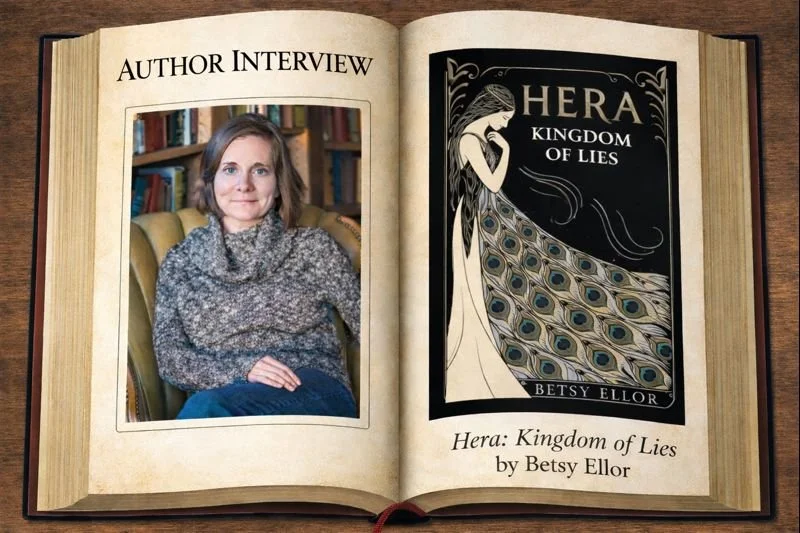

Interview with author Betsy Ellor

Today our guest is author Betsy Ellor and is here to talk about her just released novel: Hera -Kingdom of Lies and a bit about her writing process and going the indie publishing route. 

Congratulations Betsy on your debut novel Betsy, and welcome to Scribbler’s Ink.  . 

Can you share what first sparked the idea for this story? 

For this novel, there were a few different sparks. I’ve always loved mythology, and after I became a working mom, my sympathy for Hera grew. Hera is usually portrayed as petty, jealous, vengeful, and also kind of a wet blanket to the other gods' games. I think any woman focused on their career, but also balancing all the pressures that go with raising a family, will empathize with there being more to the story than what’s on the surface. That was in my mind as I read the old myths, but the idea didn’t solidify into a story until I found out about the Heraion in Samos, Greece. This temple to Hera predates the myth of Zeus. When I realized that in ancient times, Hera was worshipped long before the rest of the Greek pantheon took shape, I had a million questions: What did that world look like? Why did it change? How did Hera feel about it? Those are the questions that lit the flame that became the story.

Women’s fiction often centers on relationships, growth, and inner change. What themes felt most important for you to explore in this story? 

Hera is in soooo many of the Greek myths. I had a lot to sort through while developing the story. As I played around, I realized one theme kept resurfacing: how does a person balance who they are with what society expects them to be? Hera was assigned the role of overseeing the dominions of marriage and family, but she is married to a god defined by his infidelity. She is tasked with embodying perfect motherhood, but her first child is the literal God of War. What must he have been like to parent as a toddler? The conflict between her self-identity and the expectations placed upon her lead Hera to some bad choices on the journey to discovering who she is, how she wants to exist in the world, and how to claim her true power.  While this setting is historical those themes still resonate today, especially with women who are trying their best to be professionals, mothers, friends, and wives when we are bombarded with media telling us conflicting information about what those titles mean.

Was there a particular character who felt especially close to your heart as you were writing? 

What?! I can’t pick just one! Ok, if I must I’ll pick Panoptes. He is a mute giant with eyes all over his body. He crops up in the myths a few times to help Hera. (He is commonly referred to as Argos Panoptes, but Argos is also a setting in the story, so I simplified his name.) Panoptes is a quiet, fun-loving, and a solid, supportive presence for Hera. With every revision, his role grew because he is exactly the friend any of us would want by our side if we we going through a lot, like Hera does. 

Did any scenes or moments surprise you as they unfolded on the page

As with any retelling, you have a structure of moments you must stay true to, but I was constantly surprised by the ways I was still able to either flip a well-known story so it had a whole new interpretation or connect the old stories in a new way. I connected a character from one myth with an action from a different myth and have those two things interact to explain how a third myth came to be. It all stayed true to the original, but also created something new - sort of like doing a connect-the-dots, but out of order, resulting in a whole new, fresh picture. 

Without giving anything away, what do you hope readers feel or reflect on when they reach the final page? 

I hope they feel seen and inspired; also empowered to be ruled by their own inner compass and sense of identity rather than roles forced upon them. 

What does your writing process look like? Are you a planner, a fly by the seat of your pants writer, or somewhere in between? 

I usually write about 30-50 pages on instinct, letting whatever is trying to come out freely flow. By that point, I have a sense of what I’m trying to do, so I can create a loose outline. I find that if I outline too tightly too early, the work stops being fun. My first drafts are pretty bad, but I enjoy editing heavily to get the story where it needs to be. 

What did a “good writing day” look like for you while working on this novel? 

This novel was one of those unique gifts the muse gives out. I wrote the 130K word first draft in 3-4 months. That is not normal for me. If you are a writer, don’t read that and get discouraged. I was going through a stormy divorce at the time and had both a lot of emotions to tap into and a high-level need for the escape of writing. I was also only working part-time, so I was basically writing morning, noon, and night until my fingertips ached from writing. Nowadays, I write seven days a week, early morning for about an hour or so. A good writing day is usually when I can get half a weekend day to work on revisions without interruptions. 

What was the most challenging part of writing this book, and how did you push through it? 

Well, my first draft was 130K words, and I was pursuing traditional publishing, which typically wants a debut to be a stand-alone novel with under 100K words. I spent a lot of time squishing the story I was trying to tell down to fit into that box. After a year or so with lots of interest from traditional publishers that didn’t turn into a sale, I decided to indie publish. I printed it, read it and it felt rushed. It was obvious I needed to expand the story into a series. Starting basically over again was a big mountain to embark on, but I enjoyed going through and letting each moment expand. I got to create more world-building, let the characters feel all the moments in the story, to show more and tell less and to create a truly tightly interwoven plot. It was hard, but it was worth it. 

For writers considering indie publishing, what’s the one piece of advice you wish you’d had at the start? 

Know why you’re doing it. If you’re doing it to make money, that’s going to be a different list of things to do than if you just want to get the story out and have it connect with a few meaningful readers. Publishing and selling your work takes a lot of time, it can cost a lot of money if you’re not careful, and you will definitely feel pulled in a million directions. Knowing your why will be essential to guiding your choices, overcoming frustration, and letting you know when you’ve achieved your own definition of success.

Are you already working on another project or letting this one settle for a bit? 

I’m already underway with Book 2 in this series, and hope to have that out early next year.  I’ve done a few other projects in between, and I’m excited to get back to this world.

Betsy's Bio

Betsy Ellor is a women’s fiction author and multi-disciplinary creative whose work blends intrigue, myth, and magic with strong, complex female leads. Known for her tightly woven storytelling, she’s the editor of the anthology Heroic Care, author of the picture book, My Dog is NOT A Scientist, from Yeehoo Press, and scribbler of articles and stories for various outlets, including Spine Magazine, 5 Minute Lit, and The Creative Collective.

Links: 

https://linktr.ee/betsyellor

https://www.wordsunboundstudio.com

To order the book: 

https://www.amazon.com/Hera-Kingdom-Lies-Betsy-Ellor/dp/B0G2J68P4H/ref=sr_1_1?crid=3ME5A4WVRODUO&dib=eyJ2IjoiMSJ9.Ib0JjET6cjM2SHIyqmD_F-iflxWRgL0IbWVjBNKJPWO-XwvqQ2avJri4knZlUZMlL31-0-9Kuk0Aao9VMOyrHA.x79R03gYbi-kr8IPjpS6-FBrcqpqctTIQ-exjVMSV2Q&dib_tag=se&keywords=hera+kingdom+of+lies&qid=1768748719&sprefix=Hera+Kingo%2Caps%2C703&sr=8-1

New Story Published: "Hitchhiking in Israel" on Certain Age

I'm thrilled to announce that my new story, Hitchhiking in Israel, is now live on Certain Age!

Set in September 1973, this narrative takes you on a gripping journey through the roads of Israel, where an impulsive decision leads to an unforgettable encounter. Living on a kibbutz near the Lebanese border, I embraced the freedom of youth and the thrill of adventure. But one fateful hitchhiking trip turned into a heart-pounding experience that challenged my perceptions and left an indelible mark on my soul.

Join me as I recount the moments of fear, courage, and unexpected kindness from strangers that redefined my understanding of humanity. Hitchhiking in Israel is a story of vulnerability, cultural discovery, and the complex beauty of human connection.

Head over to Certain Age to read it now and get swept up in this powerful tale of adventure and reflection!

https://bit.ly/43i7x4G

5 thoughts on co-writing a book series Liz Hedgecock

Co-writing or collaborating on a book series is something that lots of writers consider. I co-wrote the Caster & Fleet Victorian mystery series with Paula Harmon, and we’ve now embarked on another series together, four and a half years after our first book together was published. This time it’s a contemporary cozy mystery series, the Booker & Fitch Mysteries, and we’ve just published the first book in the series, Murder for Beginners. 

While I wouldn’t claim to have all the answers, here are some things which have served us well:

1) Compatibility

One of the things that drew us together as writers was that we wrote in similar genres: we both had a historical mystery series on the go. But it wasn’t just that. Our styles aren’t wildly different. Perhaps most importantly, we both write fairly quickly. I can’t imagine co-writing with someone who would take a week to send the next chapter! 

2) Agree your terms…

While we didn’t have any particular expectations for the project beyond having a go, we both wanted to have a publishable book at the end. And if you’re publishing a book, you need to agree who’s going to be responsible for what. Is there a deadline? When will you aim to deliver chapters (if that’s how you’re planning to split the work)? Who will source the cover? Who will publish the book and do the marketing? How will you divide any profits? Before a word was written, Paula and I had a phone conversation (this was in the days before Zoom!) and agreed terms, which we later put in a signed agreement. 

3) But be flexible

While our agreement largely stands, we found early on that the book was running away with us. We’d initially agreed to write chapters in turn (our series has two first-person narrators, so that approach works for us), and for a chapter to be delivered every week, meaning that the first draft should be finished in around 6 months. However, we soon got to the point of each sending a chapter a day – and sometimes more. And once we’d finished the draft of the first book, another plot reared its head – so we decided to carry on. In the end, we drafted 3 books in 3 months. In retrospect, I have no idea how we did that.

4) Be prepared to give up some control

Sometimes your co-writer may have a different idea of where the narrative is going. Both Paula and I have put each other’s character into a sticky situation more than once, and Paula has a tendency to murder characters I had other plans for. However, so long as the book works, it can be fun and even liberating to go with the flow. 

5) Take the opportunity to learn and develop

For both of us, co-writing was a chance to take more risks and step out of our respective comfort zones. We learnt from each other, and in the process wrote what was then our most successful series. Writing in partnership also means that you can share at least some of the work of promoting your series. 

After we had completed the Caster & Fleet series, Paula and I both embarked on a solo spinoff series, where we took a secondary character from the Caster & Fleet books and gave them their own series. Paula’s is the Dr Margaret Demeray series, set in the run-up to World War One, mine is the Maisie Frobisher Mysteries. Both are now successful series in their own right. 

And finally, don’t forget to have fun! Collaborating can be a wonderful experience, and I’d recommend that any writer considers it, whether for a small project or a whole series – or more than one!

Bio and links

Liz Hedgecock travels between the nineteenth and twenty-first centuries, murdering people. To be fair, she does usually clean up after herself.

Liz lives in Cheshire with her husband and two sons, and when she’s not writing or child-wrangling you can usually find her reading, messing about on Twitter, or cooing over stuff in museums and art galleries. That’s her story, anyway, and she’s sticking to it.

Website/blog: http://lizhedgecock.wordpress.com 

Facebook: http://www.facebook.com/lizhedgecockwrites 

Twitter: http://twitter.com/lizhedgecock 

Goodreads: https://www.goodreads.com/lizhedgecock

Amazon author page (global store link): http://author.to/LizH

Paula Harmon is an author of (chiefly) historical mystery fiction, based in Dorset, UK, who has several writing projects underway and wonders where the housework fairies are, because the house is a mess and she can’t think why. Her novel ‘Death in the Last Reel’ was shortlisted for the Selfies 2022.

https://paulaharmon.com

https://www.facebook.com/pg/paulaharmonwrites

https://twitter.com/Paula_S_Harmon

viewauthor.at/PHAuthorpage 


Setting realistic Writing Goals

Writing a book is an accomplishment that’s often—no, usually—a difficult achievement. Even if you are a full-time, previously published writer, you need a plan. You need to set goals: daily ones, weekly ones, monthly ones, and yearly ones to successfully keep you on track from the beginning draft through revision to the final proofread. Without these goals, you will write, but not likely finish any project. 

Goals help you figure out what project you really want to work on, then how to create the plan that will bring you to and across the finish line and. Without set goals—whether small or large, short- or long-term—you will likely lose your focus. And you will definitely lose track of time. And if that occurs, you won’t finish the book you have been dreaming of writing. Writing a book, fiction or nonfiction, requires an overall plan and all the steps required for you to type The End.  

You want smart goals. You want specific goals and you want realistic goals. For example: When will you write? For how many hours—or instead of a time goal, what will be your daily word count? Knowing the answers to these questions and being absolutely honest about what you can take on make the whole process manageable and more doable. 

Here are a few tips I have found have worked for me:

What are you looking to achieve? This will determine what types of goals you need to set for yourself. Be specific, detailed. Simply stating and setting a goal of writing is not enough. Do you want to write for magazines? Do you want to write flash fiction, short stories, or a novel? Are you looking to start a podcast? Create and run writing workshops? Support your writing by getting editing jobs? Just saying writing covers a huge spectrum.

After you decide what it is you are looking to do, set your goals. Most importantly, be realistic. Setting unachievable goals increases the chances of becoming overwhelmed and then giving up tenfold. You know you the best of anyone, so don’t allow the first flush of passion for a new project because you to push yourself too hard or to set goals you know are unlikely to be realized. Chances are you won’t be able to finish your 100,000-word historical novel set in fourteenth-century Scotland in two months, especially if you are working full time and have a family and friends who expect your attention upon occasion. 

Keep track of your progress. How far have you come toward the end goal? It doesn’t matter what you are writing or what your project is, whether it’s a screenplay, a short story, a nonfiction essay, or a 100,000-word novel. If you don’t keep track of how far you have come, you will lose sight of how close you are to completing that first draft. How can you track? An easy way is to use a calendar. Write your goals on each day you plan to write or are working on a writing-related project and cross them off as you move forward. At the end of the first month, you might find something is not working for you. Maybe you realized you are not a morning person and the thought of sitting down at your computer or with paper and pencil at dawn causes your brain to freeze. You might have less time to write each week than you first thought. When you discover these things, it’s a good time to reassess and modify for the next month.

Be accountable. This, to me, is at the top of any list for goal setting, If you are serious about achieving your writing goal, you need to make it a priority. If you don’t, you will find any and every excuse to procrastinate. You will lose focus and motivation, and in the end, your long-term goals will become another memory that never quite happened. 

  • Break your goal into steps. Having a long-term writing goal is great, and breaking that goal down into smaller weekly goals is a good idea. Baby steps are always less overwhelming. 

  • Another effective means of keeping yourself accountable is to determine when and where you will be writing. Will you write every day, or a couple of times a week? How long will your writing sessions be?  Are you planning on taking weekends off? These are some excellent questions to contemplate. 

  • During your scheduled writing time—no matter if it’s one hour a week or three hours every day—you should be 100 percent focused during that time to complete your goals.The best method of making certain you are accountable is to have a writing buddy or a group of writing friends you check in with every week, where everyone reports whether they made their goal and if not, why not and how they can make positive changes to meet the goal the following week.

Rewards. I’m a huge believer in rewards, small and large. They are a terrific motivator and one you should absolutely consider. For example: if you write every day you scheduled in a week, you get to buy yourself something small, but nice. Maybe a new notebook, some stickers, new pens. If you reach your goal for a month, the reward should get larger and more fun. Example: Sign up for that writing class you have wanted to take; or maybe it’s a non-writing reward like taking a painting class, going skydiving, or buying that pair of shoes whether they are on sale or not. Come up with something that excites you. 

Last but not least, don’t give up. You will have down days when you can barely form a word that pushes your story forward in any way. Or maybe you’ll decide halfway through that the story is crap and you have no talent. Kick that evil self-critic to the curb and take a break, a pause, a breath. Go for a walk, or listen to a podcast that features your favorite author. Or put your work away until the next day. Then reset and come back fresh. Don’t give up. 

As writer Nora Roberts said: “I can fix a bad page. I can’t fix a blank one.”

Happy writing!


People, you can tell me anything by Shelagh Braley Starr

As might be true of most writers, I have a fair number of voices overflowing in my mind. It can get pretty noisy between my ears, especially when I am in the early stages of constructing a story.

“Did you hear?” They gossip at me like crows. “The hero is a humble lover. The maiden is actually an immortal warrior. The druid is the king’s father but no one knows!” These characters save all their secrets for me, and it’s my job to listen and get it all down on paper somehow, in a way that both makes sense and prompts readers to care.

Their voices compete for top billing: Who will tell this story? Who has the most at stake? Whose point of view captures the full picture best? That is the most difficult choice I’ve faced so far. I’ve only known them all long enough to write a first draft, and that’s hardly a lot. I get the sinking feeling they’re still hiding some prescient details from EVEN ME, their dearest confidante and scribe. But writing is not for the weak of spirit—I must be decisive. So, I go with my gut and choose the character I relate to with the most depth.

Writing from first person, I slide into the form of the protagonist, wearing her velvet gown, pulling back her swath of hair, hefting a sword for the big, surprising battle. We become one person while I write for her, her words defiant, her thoughts in contradiction. I get to experience this with her. She’s conflicted! She’s ambivalent! She’s struggling to adapt to the changing expectations! It all feels so close, her struggle becomes my emergency as I write. Between us now, there is familiarity and intimacy. We are twins with extrasensory powers of understanding, as hers become the violet eyes through which I see the action unfold. And hopefully, that closeness will translate to readers as they come to know her, to witness her internal struggles, to watch her evolve and get stronger, to respect and love her as I do now.

But then … oh no. The hero is heartbroken and full of regret, his fighting days seemingly behind him. What’s that like for him? My empathy overflows, but I have to hold onto my chosen point of view. I cannot be two people at once, as much as I wish I could. If I am in the maiden’s thoughts, then I only get to write what the hero does and says out loud. Yes, the insight is limited, the internal struggle cut down to the visibly grimacing jaw and the heavy sigh as his breath clouds the stars on a cold, clear night. HOW FRUSTRATING. What is going on in that golden-haired head of his? Of course, I do know what he wants, and what he’s feeling is juicy! But I couldn’t possibly say. It’s private information. Maybe if he finally confesses to me … I mean, to the maiden—then we’ll know for sure.

And meanwhile, what’s that druid up to?? I am sure that potion he’s making is deadly. But is anyone else aware? No, that’s for him to know and everyone else to gasp in horror when they find out. Who could imagine he was such a villain? Well, when he fooled the queen into making an illegitimate heir, it was pretty obvious, but why? Why would he do it? Is he power hungry? Is he fulfilling a prophesy we haven’t heard about yet? If only I had inside information on this one, because the maiden is too busy training and the hero too deep in his pining to notice any sneaky business. I’ll have to keep my ear to the ground and my eyes peeled.

What I do know is that although there are many voices that make up a story, taking one perspective and sticking to it is crucial. If my maiden is as tough as I think she is, all will be revealed in good time. I just have to be patient and keep these secrets to myself.

I wouldn’t want to be thought a scandalmonger, now, would I?

Shelagh Braley Starr was born in Kittery, Maine, the youngest of four girls. Educated in Catholic schools on the Seacoast, she became an insatiable reader, and developed a special interest in mythology, Irish politics, and history. 

She studied journalism at Northeastern University, working at both daily newspapers in Boston before transitioning into tech entrepreneurship. Her work has been published in The Boston Globe, Boston Herald, Family Traveller, and more. 

She lives in New Hampshire where the sailing is good, with her husband, daughter, son, and a pack of wild Labs that ruin any attempts at gardening. She is working on her first novel, Emer of Ulster. 

Setting The Mood by Bobbi Lerman

Setting is more than a place. It’s more than a simple description to establish where a character in a story is living or traveling to or just hanging out for the moment. Setting is more than an inconsequential backdrop between action scenes or romantic scenes. Setting is mood, atmosphere, tone. 

What is a simple definition of setting? 

Setting is the location where the story takes place. It includes the region, the look of the landscape, the climate, the buildings, and the interiors of the buildings. It might be the look and feel of the underground tunnel you character is trapped in or the ambiance of the bedroom where you spent your honeymoon. Setting can suggest the passage of time by the use of light, weather, or the hour of the day or night. 

It doesn’t matter if you are a novice writer or a seasoned one. As a writer, you need to understand the fundamental elements of setting to create a story that will draw a reader in and keep them turning the pages. The setting of your stories and how you present it is a crucial element to storytelling, whether it be fiction or nonfiction.  

Readers need to visualize where your story takes place. They need to feel like they are experiencing it as if they are there themselves. Your readers need to believe not only where they are but when—otherwise as a writer you will lose all credibility. When your story takes place will determine what words can be used to tell your tale. For example, the word noisome (which refers to a small that is particularly 

Disgusting disgusting or unpleasant) came into usage in 1350. However, the word confidant (which refers to someone to whom secrets are entrusted) was not used until 1705. You wouldn’t use modern-day medical procedures in a story set in the early nineteenth century, or have one of your characters flick a switch to turn on a light in 1403. 

One of my favorite quotes by Edith Wharton: “Every story would be another story, and unrecognizable if it took up its characters and plot and happened somewhere else.”

Think Harry Potter in a Kansas one-room schoolhouse, or Jane Eyre in in a beach house in Malibu. 

And then there is time. Did you know there are four kinds of time in a story, each with its own unique role to play? There is clock time, calendar time, seasonal time, and historical time.  

What is the difference, you ask?

Clock Time will often create a mood or feeling. It can ramp up the suspense or the depth of creepiness. Think your protagonist, alone (or he believes he is), investigating supernatural happenings at an abandoned house, but he needs to wait until the clock strikes midnight. 

On to calendar time, which settles us in the year, the month, and the day, usuallyspecifically the day or the week. Americans will recognize April Fool’s Day takes place every year on the first; however, they would not necessarily have a clue when Boxing Day is in England or when exactly Carnival takes place in Venice, as other countries have different calendar dates that would be significant to their culture.  

Next up is seasonal time, which refers to the four seasons. Consider how differentthe atmosphere of your setting, the ambiance, would be if your story took place in February in North Dakota versus St. Barts at the same time. Your characters’ dress would be informed by what season they were living in. Their activities would be dictated by the weather. They won’t snowboard in Florida in April and they won’t go swimming in one of the Great Lakes in February. 

Last, but not least, we have historical time, which most often lends to establishing behaviors and attitudes that impact your story’s setting. How people communicated was dependent on the time in which they lived. Expectations of women, for instance, were far different in the 1950s than in the late ’60s or early ’70s. Slang changes radically over the years in the States. Common words used all the time back in the eighteenth century are outdated today or not used at all because they are offensive or recognized as racist. How religious people were, as well as moral and societal attitudes, were often determined by the time. 

Place: Where are we? 

Place is more than simply a physical description of where the character is. It should involve more than one of the five senses, such as sound, smell, taste, touch. Someone who is waiting for a train in Moynihan Train Hall in New York will have a far different experience a person waiting in an old church in the Italian countryside. 

There are the non-physical characteristics of the setting that will impact your story. What is the education system of your location? The upper-class schools of Beverly Hills will be much different than poverty-stricken areas of Detroit, or a parochial school. Neighborhoods, social standing, and economics all put characters in different settings, no matter the year.   

Combining the different elements is key. Setting is the context, the foreground of your character’s actions. People exist in a specific time and place. This will contribute to personality, values, and what kind of problems or obstacles befall your protagonist—or villain, for that matter. Setting impacts how the cast of characters that peoples your tale react. 

If The Help had taken place in sunny Southern California instead of the ‘60s American South, would it have worked? Or take The Wonderful Wizard of Oz and instead of tornado-stricken Kansas, set it in Mars int eh year 3022. Somehow, I don’t think it would have the same lure to the same readers. 

Setting is as equally important as plot or character. Writers will spend hours strategizing and brainstorming story arcs and conflict, and pay little attention to where everyone is. A big, BIG mistake. The place your story is staged provides the backdrop for where your drama will play out. 

What are some of the elements to setting?

  • Locale: This covers everything from which country or state to neighborhood, street, or even a specific house. 

  • Time of year: Which season is it? Are your characters sweating in the heat or skiing in deep powder? It is a holiday or a significant date such as the anniversary of your heroine or hero, or of a battle perhaps? 

  • Time of day: Is it night, dawn, or twilight? The time of day your story is set is an important feature and may vary throughout; however, it will create a particular visual in scenes. 

  • Elapsed time: Over how many minutes, hours, days, weeks, months, does your story play out? You don’t want to confuse your reader by not being clear. Is the passage of time important to your story?

  • Weather: Does the weather and its lighting effects influence events in your story? If your protagonist is running through a desert for help at midday, the feel and the mood are going to be significantly different than if they are making their way down a city alleyway on a foggy night. 

A few more elements you might want to give some thought to: climate, geography, era, social/political/cultural environment, population, ancestral influences. Setting can and should be a character in its own right. Think of it as painting a portrait of a place where the central character is the place  linked to the protagonist. One of your goals as a writer—and yes, we as writers have many goals as we weave our stories—is to make the setting a part of the heart of the story. 

A few last tips: 

  • Give your setting purpose. Remember it is its own unique character with its own unique voice. 

  • “Show, don’t tell” as much as possible. Show the ferocity of the storm, the thickness of the fog, the wildness of the waves, or the rhythm of the city. Don’t tell your reader it’s the Scottish Highlands in 1309—show the landscape, the thatched cottages, the laird’s keep. 

  • Detail, detail, detail. Is it a luxurious BMW or a beat-up Volkswagen bus your protagonist is driving? Is your heroine staying in a plush hotel sui9te or a weathered saltbox cottage on the edge of the sea?

  • Use all your senses. What does the place look like, smell like, sound like, taste like?

Last, but not least: Don’t describe setting all at once in the beginning. Work it in slowly throughout the story. Let it unfold as the story does.

Happy writing!


10 Tips for Finding Memorable Character Names for your Fiction by Anne R. Allen

Is choosing the name of your character important? Does it have any bearing on how you tell the story of how a reader may respond? A name can contribute to defining your protagonist's personality or help a reader relate or identify with a character. Choosing a name for your protagonist or secondary character's can and has often sent me down the rabbit hole of research. Here are some tips I found interesting from Anne R. Allen's blog. Click HERE to check out her blog and let me know your thoughts on this process.

Let’s Talk: Ramping up your dialogue

The most difficult aspect of the writing process, for me, is creating dialogue. Give me a setting and I can put you right there so as a reader you will believe you are walking through the Scottish Highlands five hundred years ago. Ask me to get my character from one side of the room to the other, no problem. A sentence or a well-crafted tagline will accomplish what I need nicely. But getting my hero and heroine to have meaningful conversations that move plot, tension, conflict, and, yes, romance forward and does not just fill the pages with meaningless words—well, that continues to be a definite struggle. The thought of having to create dialogue often causes my stomach to clench and my brain cells to run off in fear.

However, I have realized that despite my best efforts to simply avoid it in its entirety, all stories—short stories, full-length novels, fiction or nonfiction, and memoir—need dialogue to craft a good, readers-will-want-to-turn-the-page-from-first-to-last tale.

So to overcome my obvious resistance, and my terror that my dialogue would cause readers to cringe, I decided to face my fears. I began by reading all the articles I could find on writing riveting, believable dialogue. I read. I read some more. I read novels and memoirs, and studied the cadence of conversations between characters, even the most minor ones that have only a couple of lines within the pages. I practiced writing and re-writing my own sorry-ass pieces of dialogue until I began to see some improvement. Yes, I have improved, but it takes practice. Good writing takes practice. I eavesdropped on conversations while sitting in cafés, browsing about bookstores, waiting in restaurants. I practiced writing more dialogue until I detected more development in my skill set.

Dialogue can be complex. Dialogue can be simple. Dialogue to make your story worth reading to anyone except your mom, best friend, or partner must be spot-on terrific. Through my incessant study, research, and conversation with other writers, I have come up with a few observations and suggestions for crafting richer, more nuanced story conversations that enhance your plot rather than just fill pages with unnecessary talk.

Every line of dialogue needs to be there for a reason.

Dialogue shouldn’t exist simply as filler in between action scenes and because you can’t figure out what to do with your characters. Story conversation should serve a real purpose such as building tension/conflict, revealing important backstory, establishing a mood, a new setting, injecting some humor, but always moving the plot forward.

If you can take out a line of dialogue, or if you feel you can remove an entire conversation from a scene without it impacting your story in any significant way, then more likely than not the dialogue is filler—words on the page for no purpose.

Characters who people your stories, like real people who are in your real life, are usually complex and multifaceted.  Each character, whether created from your imagination or based on a real person, should have a unique voice that makes them stand out. Voice is not simply about what a character says, but about using both verbal and nonverbal cues, their individual personalities, self-esteem, views and opinions, and the culture they were raised in. Crafting strong, authentic dialogue that shows the varying degrees of subtlety and shading can be a thorny process, but worth the time and effort.

By the way, perfect speech is not necessarily a good thing—at least, not for every character you have on the page. When people speak, few people/characters talk with perfect grammar, complete sentences, polite sentences. Some people curse all the time, others might blush fire-engine red if they accidently utter a mild curse word aloud, never mind  “fuck” (an adjective for me in real life, though one of my closest friends used to apologize every time she said the word). People are messy. Your characters should be too.

Questions to focus on:

What is the relationship between the characters involved in this particular dialogue?

What is the circumstance in which the conversation takes place? (This can often shape the context.)

For example, how two lovers talk about the weather will be much different than how that same conversation takes place between an estranged mother and daughter, or perfect strangers meeting for the first time.

Body language and facial expressions are vital.

When people converse, they also make faces or move their bodies, such as drumming fingers, tapping feet, shifting from one foot to the other, clenching hands into fists, rolling eyes, not making eye contact, visibly tensing, farting, something. People relay as much important information with the use of body language and expressions as they do with their words. Sometimes more.  A character’s mannerisms are an integral piece of creating dialogue that will engage the reader.

Find balance.

Not everyone gets equal time on the page or in each scene. Just like in real life, some people talk more than others. Some people go on and on and on, yet say nothing. Others can say an enormous amount with the delivery of one or two words. When you are writing dialogue scenes, take into account the dynamics of power and which character is holding it.

Ramp it up.

Tension is what I am speaking of here. Dialogue exists—well, ninety percent of the time it exists—to create or resolve story tension in some way. Remember, it’s the tension, the guessing what is going to happen next, how a character is going to react or behave, that will keep your reader reading.

Read your dialogue out loud.

Last, but not least, read your dialogue out loud. Whether you read it yourself or having someone else read it for you, hearing it is the best means to discover if something doesn’t sound authentic or believable. Hearing the words of your characters’ conversations is where you will discover if the dialect you are using is not working, or if the conversation feels stilted or just unbelievable.

It doesn’t matter whether you write novels, short stories, flash fiction, or nonfiction; it is beyond important to know how to write compelling dialogue in a story. Read up on the topic. Take a class that focuses especially on dialogue. There is no one article that covers all aspects of this topic. I have barely touched on various aspects of it here. There are many differing opinions from many, many writers. Take in as much as you can, keep the best of it and make it your own.

My last piece of advice for craft improvement: Make the writing of dialogue a top priority.

Happy writing!

9 Tension-Building Elements For Character Dialogue By Becca Puglisi

Dialogue takes care of so many aspects of a story. It’s an effective way to weave in back story without it feeling like an information dump. It’s an excellent way to move the story forward without a great deal of extraneous sentences. It’s also one of the best ways to ramp up the tension. I found the blog piece on Writers Helping Writers. I thought the piece interesting and helpful and thought I would share. Click HERE to read this blog written by Becca Puglisi. I hope you enjoy it as much as I did!


Dream Journaling for Writing Inspiration

“What dreams do is raise the emotional level of what I’m doing at the moment. They add color or counterpoint to the arc acting as an almost symphonic accompaniment to what I’m doing.

–Maurice Sendak, Writers Dreaming

Whether you are a novice or seasoned writer, you have had periods—sometimes brief, sometimes long—when nothing comes to mind and you find yourself staring at the blank page. Or you have several ideas to write about, but you find yourself unable to focus on how to write it and find yourself facing the feared writer’s block. Wanting to work through it, you go to your usual methods. You take long walks, look through old photos and newspapers for inspiration, or sit at a café, eavesdropping on others’ conversations in the hopes that creative lightning will strike, unaware there is another alternative.

Has a plot or a character, fully developed, ever come to you in a dream? If you are anything like me, you woke up and thought or said aloud, “What a fabulous idea. I should write that down before I forget.” And then maybe you didn’t want to move from under the blankets, or maybe you couldn’t turn on the light without waking your partner, who would not be happy with you if you woke them up in the middle of the night and started going on about this great story idea. (Though, in my opinion, this should be a prerequisite when considering the characteristics of a good life partner.) Maybe you couldn’t find a pen/pencil or paper handy so you told yourself you would not forget the page-turner of a plot or irresistible protagonist your dreams gifted you with, then you turned over and went back to sleep—only to find when you woke in the morning after a nanosecond, the images had disappeared.  

Writers should always have a dream journal by their bed. 

What I discovered is that dream journaling is one of the best, most fail-safe methods to tune into your creativity as your subconscious does not typically possess the insecurities and doubts we tell ourselves during our waking hours. Scientists believe—well, they are pretty certain—those dreams help us process information, synthesizing it in a way that grows and empowers our creativity. A writer’s dreams can help with unique ways to solve a plot hole, or a character development problem, or stilted dialogue that is simply not working. Paying attention to dreams helps you become aware of new, not fully formed ideas that don’t necessarily make sense, but that you need to connect with to move past your block and get insight into what you are writing.    

Dreams are an integral piece of our creative center or soul to help you evolve as a writer. It is in this other dimension that we are able to surrender control, lock out our critic, and allow anything to happen. It is where our characters are free to come talk with us and let us know the true path they should be on—too often, not the path on which we have taken them. It is the mist-filled world where what feel like impossible scenes to write our way out of can often find resolution. You, as a writer, are missing out on some serious creative mojo if you don’t keep a dream journal. Yes, I am going to keep stating this fact. 

Writers are dreamers by nature. Learning to tap into the magical source of inspiration and creative energy dreams afford is beyond beneficial to the process of writing, whether you are creating a fiction or nonfiction piece of work. The link between dream imagery and what it symbolizes is what causes the creative sparks within you to fly when you sit down to work, hoping as you place your fingers on the keyboard or pick up that pencil that the muse deigns to appear and inspire your poem, short story, or novel. 

Some examples of stories that were inspired by dreams: 

Jonathan Livingston Seagull

Richard Bach said that after he heard “a disembodied voice” whisper the title in his ear, the story began to form—though it wasn’t until eight years later, after a dream that featured the famous seagull, that he was able to finish his hugely popular novella.

Frankenstein 

While hanging out in the 

Swiss Alps in the summer of 1816 with Lord Byron and Percy Shelley, Mary Goodwin (Mary Shelley) went to sleep one night after being unable to come up with a suitable tale to tell for that night’s ghost storytelling contest. She found herself dreaming of the immortal monster that would become Frankenstein, waking to realize she had found her ghost story. 

Catch 22 

One of the best novels about war came unbidden to Joseph Heller, who had served in World War II. He was lying in bed in his apartment on the West Side of New York when the lines came to him: “It was love at first sight. The first time he saw the chaplain, someone fell madly in love with him.” At this point, Heller did not have the name of this character. He wasn’t even sure he was an army chaplain or a prison chaplain, for that matter. Heller has said the minute the opening sentence formed in his dream state, the book began to evolve clearly in his mind.  

How to take advantage of your dreams, you ask? Be aware. Be open to the magic of dreams and their power so you are able to learn to use them to your writing advantage. There are several actions you can take. Here are a couple I have used that have worked well.  

  1. Pay attention to your dreams. If they wake you up, write down some notes, even if it’s just general ideas of theme, plot, character, or setting that you have seen. The whirl of images tends to quickly fade. Dreams tend to be an excellent jumping-off point for the creative process.

  2. Make a conscious effort before going to sleep to concentrate upon any story points you are struggling with or blocked about. Just before you feel yourself growing sleepy, focus on the problem. Your subconscious won’t forget and will often work hard to offer you a resolution upon waking. Setting a specific intention will activate your mind and the likelihood that your dreams will respond to that intention.  

  3. If you have difficulty remembering your dreams, there are ways to train yourself to retain them better. Here is one I particularly like: As you fall asleep, repeat a mantra that will direct your brain to remember your dreams. An example I often use, that I once read about in a book on dream recall, is “I will dream tonight, and I will remember my dreams when I wake.” If you want to learn more about dream recall, there are a wide variety of books and articles about this subject. 

One of the many bonuses to keeping a dream journal is when you next find yourself staring at the blank page without a clue what to write next, you can pull out your dream journal and expand on any of the ideas or characters your entries bring up. Even if you find just a few details scrawled on the pages about the images or the colors of the dreams, they will likely be helpful—if not for your current work, then it will most definitely be an excellent resource for future projects. 

Dreams are mysterious. Dreams are magical. Anything and everything can happen in our dreamworlds as they represent the far reaches of our imaginations. If we are lucky, they might read like a road map to where you need to go. Dream journals offer the capacity to turn their images into poems. Their often-scrawled words can be the catalyst for transforming your nightmare monsters into the needed creepy or evil villain for your short story or novel.  Dream journals can act as an idea warehouse that you can access at any time for any type of writing project. 

So my best advice is to never forget that dreams are tricky, and to outsmart your dreams by writing them down immediately upon waking to keep them fresh. Write down everything you are able to remember, from colors to sounds to smells to what the people in your dreamscape look like. In the end, it’s all about writing it down. Your creativity will flow. Your muse will thank you!

To finish, I leave you with a favorite quote of mine:

“The brain is so strange and wondrous in its mystery. I think it creates a number of things for itself—it creates launching pads and resting places—and it lets steam off and it reworks itself.” 

—Maya Angelou, Writers Dreaming

Happy writing!


Weather to Write

Does your muse pull the blankets over your head and give you her most confident you-don’t-tell-me-what-to-do-dearie sneer at the sound of a driving rain hitting the window panes? When the sky is the perfect summer cloudless blue and warm sun is streaming down, does your muse blow you off and head to the beach?

Weather affects our moods. Weather affects our productivity and our creative flow. It only makes sense that the weather can also affect our muse.

How do you entice her back, you ask? There are a variety of schools of thought on this matter. Some say ignore her, some say play hard to get (yeah, right, like any self-respecting muse would fall for that old trick), or some even say show her your independent streak, telling the old girl you don’t need her, that you’re just fine on our own.

Problem is, muses tend to be highly intelligent, perceptive, and all-knowing, and your BS is going to bounce right off her. A negative thought will send your muse hopping onto the next train out of Dodge until there is a definite atmospheric change.

Now, me? I say that at times like these, there is only one road to go. A change of venue is what is most likely needed. Forget cleaning the bathroom, doing the laundry, figuring out which bills to pay, making supper for your husband (he needs to learn to cook!). Kick out your inner drudge. Embrace your repressed adventurer, and follow her.

If she heads to a nice sandy beach, I say anchor your umbrella in the sand and get to writing. Your muse turns out not to be a beach person? Not a problem. Settle in with her at an outdoor café. Even at a safe six feet apart, you can still listen in on the conversations around you. Writers are not only allowed, but expected to do this. Not to mention, the best dialogue and lines have been discovered from a good eavesdropping session. Do you really believe Shakespeare came up with, “A plague on both your houses” by sitting around the house moping?

If your muse turns out to be a film buff, take advantage. Curl up with a foreign film together and listen to her when she instructs you to read the emotions playing out on the screen.

My muse tends to be an active one, seeking new experiences, scents, and visuals. Your muse, on the other hand, may prefer a walk, or stretching out on a soft patch of grass and studying the clouds, or a simple but energy-replenishing nap. No matter what, stay with her, listen to her suggestions. Be grateful she is letting you hang out with her on an unexpected walkabout.

At the very least, it’s time well spent. In the end, the lesson is not necessarily about how many words you wrote that day. The lesson is that the weather always changes and while you’re waiting it out, you might as well have some fun!

Eavesdropping: Bad Habit or Natural Instinct?

Did you know that eavesdropping provides excellent benefits if you are a writer? Eavesdropping will improve the cadence of your dialogue, make it more believable not to mention enhance your ability in describing a character’s body language which is another form of dialogue. Today I’m sharing Nadine Clay’s article; How Writers Can Use Eavesdropping to Improve Dialogue. Happy reading and we look forward to hearing your thoughts!

Click HERE to read her blog.

Five Tips For Writing Tighter Sentences

Critique partners, agents and editors are known to call for tighter sentences from writers, but often offer little direction on how to accomplish this.

I have a fantasy where I sit down, turn on my laptop, and words flow from my brain to my fingertips and onto the page in a perfect publication-ready state.

Never happens, and I don’t expect it likely ever will.

I love words. My tendency is to use many to say something I can say more succinctly with a few, which is likely why the short story genre is one that has never appealed to me.

I remember the first time I gave my work to someone to read and the dismay I felt when she handed my three chapters back to me with the pages covered in red ink, sentences and entire paragraphs crossed out. She then pointed out how, though my flowery description of the Scottish Highlands made her want to buy a ticket and go there, she had to wonder if I was writing a novel or a travelogue. Along with this first memory is the better, longer-lasting one where I realized how powerful my story became with the fluff cut away.

Professor Strunk stated it the best: “A sentence should contain no unnecessary words, a paragraph no unnecessary sentences, for the same reason that a drawing should have no unnecessary lines and a machine no unnecessary part.”

Below are some tips that help me write tight:

  • Avoid wordiness; eliminate unnecessary words.    

  • Trim flab, cut the extraneous whenever possible. As much fun as it may be to research, resist sharing every fact and obscure piece of folklore you’ve uncovered that isn’t’ integral to the story.  

  •  Cut the boring parts-work to make each sentence count toward moving a scene forward.                                                                                                                                                

  • Write with passion.     

Happy Writing!   


The Opening Hook: How to Draw Your Readers In

The hook is a tried-and-true technique to snare the readers attention to a degree that she will keep reading even if the family dinner is burning to a charcoal crisp on the stove, her partner says they have something important to discuss, or her all-time favorite television show is about to begin. A good hook leaves the reader unable to resist turning the page. A good hook tugs at your emotions and gets under the reader’s skin, compelling her forward into the story to follow where the writer wants her to go. 

An opening may consist of one line, several paragraphs, or several pages, depending on whether you are writing a short story or a novel. Hopefully the hook is part of your opening sentence, as you want to—no, make that, you need to—engage the reader immediately. Whether you use evocative words, humor, lust, or maybe shock to convey the emotion of the scene, you want to strive for something other than predictable. Different, in this case, is good. Different can often make for a best-seller. 

 We’ve all opened a book with anticipation only to read an opening that leaves us flat. An example of what would likely send any reader into a snooze is if in your opening pages your main character, Lydia, wakes, slides out of bed, and puts on her slippers. Then she makes her way downstairs to the kitchen, deciding if today she will make eggs or pancakes for her husband. After this, she weeds the garden, does some shopping, and drops off the dry cleaning.

 Would a reader care a fig about Lydia? Doubtful. I know I wouldn’t. If you’re bored reading a dull, mundane opening, think about how your reader will feel. Something has to occur in your opening, something that poses a question your reader wants/needs answered; otherwise, you’ll put them to sleep ... or worse, they'll just put your book down, never to return to it. 

 Taking the same scenario, what if in the opening pages Lydia steps into the kitchen to find her husband holding a bloody knife over his head, and their nosy neighborhood association president sprawled and bloody on their freshly grouted white tile floor?

 Now, this is far more attention-grabbing. Not that you necessarily need to have a bomb exploding, blood flowing, or an orgy taking place on page one, but you do want that important something to happen before the reader is yawning and decides to put down the book and go watch whatever reality show is on television that night instead.

 Keep in mind that beginning in the middle of an action scene does not necessarily make your opening a strong hook. You need the lure of the reader wondering what will happen next or what caused the action to occur in the first place. Other things can be used for a strong narrative hook: a mysterious setting; engaging, provocative dialogue; or an intense love scene (my personal favorite).

 Choose where to begin your story with the utmost of care. It can mean the difference between getting your manuscript read or thrown into the editor’s towering slush pile after a few more paragraphs.

Editing The Kitchen Sink

Editing is such an important part of the writing process. I wanted to share this blog by a wonderful writer, and my friend, Betsy Ellor. Click on the link to read “Editing The Kitchen Sink” on her website Words Unbound. Happy reading and I look forward to hearing your thoughts on this piece!

Betsy Ellor is the senior editor for Words Unbound Studio. When not writing she spends her time hiking with her dogs in the woods of Massachusetts.

Practice Writing: What is it And Why Should Do It?

What is practice writing, why do it? Well, the simple answer is it’s just what it sounds like: practice.

Have you ever heard of a concert pianist making their debut without years of practice? I am absolutely certain Yo-Yo Ma practiced the cello a lot, just as I am positive Jack Nicklaus spent hours upon hours hitting golf balls. Monet probably did a lot of practice sketching before the final version of his “Water Lilies.”

Yet so many writers think they should just be able to sit down and write that Pulitzer Prize winner on the first or second sit-down, with no warmup whatsoever. 

Free writing—or practice writing, as Natalie Goldberg calls the exercise in Writing Down The Bones—is one of the best tools for writers of all levels, from the person looking to write their first piece to the seasoned writer needing to break through an endless block and reconnect with their lost or forgotten muse. Timed prompt writing never fails to jump-start one’s creative flow, lead a writer to discover their voice, or strengthen the voice already in place.

What is this? How does it work?

Practice Writing

Practice writing is simple. It can be done alone or with a group, though personally, I find the group setting more fun. All you need to do is pick up a pen, set a timer, and write for five minutes, ten minutes, fifteen minutes, or longer if you find your muse kicking in. The inner critic is never allowed. They should be treated much like a vampire: without an invitation to enter, they cannot cross the threshold. 

The exercise of practice writing is all about loosening your thoughts and setting them free. It’s about uninhibited flow and building self-confidence. It’s about blasting apart any blocks standing in your way, including fear of failure, inner critics, anxiety, or any other forms of resistance you can dream up. If you have an idea that has been percolating in the back of your mind, but you can’t quite seem to get it out, try a few sessions of practice writing. It will help.

Is there a particular technique?

Apart from setting a timer and picking up your pen, the answer is no. You can choose a topic if you want to have some structure, or expand on a particular subject that has been on your mind. You can write from your own life, or from a character in a story you are working on or thinking about developing. I’ve often found when I don’t know what direction in which to take a character, writing from their point of view helps.

Willingness to take a risk is always to be encouraged. There is no need to worry about perfection or publication. Grammar and spelling are unimportant in this stage. Editing is not allowed. The words created in this exercise are not ones you need to let anyone see or hear unless you choose. The purpose of the exercise is to keep your hand and your pen moving across the page continuously until the time goes off. Feel free to stray off topic, letting your thoughts go where they will. Remember, practice writing is just that—practice. Good, bad, brilliant … it doesn’t matter. Keep writing.

If you can’t think of anything to write, scribble I can’t think of anything to write or the line of the prompt over and over until a line of thought crystalizes.

The key to a successful practice writing session is to get out of your head. Do not overthink; just pick up the pen and write. Do not stop and reread what you have written until the timer goes off. The point is to get the words flowing out of your brain and onto the paper. If you stop to worry over whether what you’ve written is good, then a block will be thrown up rather than torn down—and breaking down those blocks is the point of the exercise!  

Practice writing is the ultimate blockbusting tool with only one rule: WRITE!


Plotting vs. Pantsing: What Type of Writer are You?

Are you a detailed outliner or do you prefer Pantsing? Do you really know what it means to be a true Pantser when it comes to writing your novel?  

I was procrastinating and doing a bit of web surfing while really figuring out how to write myself out of a scene I was currently working on when I came across this article by Lauren Sapala on What “Pansting” really means. I found it  more than a bit interesting and I discovered I am a combination of the two.  What are you?  Click HERE to read Laurens’ article.


The Lure of the Research Rabbit Hole and How to Avoid Falling In

While I was researching on the internet the other day, looking for interesting blog topic ideas, I found myself—despite my resolve—distracted by a variety of articles on topics from folklore surrounding white horses in Scotland (which I decided I will write about in the future) to one of the oldest curse words, what it means, and how it was used. (From what I surmised, there are quite a few to choose from: Egyptian, Viking, and Japanese. Did you know the word “swive” is the medieval equivalent of the word “fuck”? Not totally unhelpful, as the heroine of my current WIP lives in fourteenth-century Scotland and swears a lot.) I did like the word “shiteater” from the Egyptians (though pronouncing it in the original language is impossible). And then, of course, how could I pass up on reading an opinion—well, more like a debate—on whether the actor playing Rip on “Yellowstone” was hotter than the actor playing Matthew on the series “A Discovery of Witches”? I admit, it was close, but in the end, I had to go with Rip.

Two hours later, with no topic chosen, and not a word written, I stared at the blank screen and realized I had gone down the research rabbit hole once again. If not for all of us, it is for a large percentage of writers so, so, tempting to procrastinate getting on with our first draft or beginning revisions when we know we need to cut scenes we love and labored over but don’t actually move the story forward. Or we have to add scenes because we missed a major plot hole. What better way to put off these difficult tasks than to get lost in the research of some oh-so-fascinating fact or piece of trivia that is not necessary or needed?

By the way, it’s important to note: you don’t need to become the foremost expert on anything for a first draft, or even when you revise. I, for example, do not need to know the entire history of Scotland. I just need to know before I write what is going on in my protagonist’s world and how, historically or politically, it might affect them. Yes, it’s important to understand the details of the world your characters are inhabiting, but you don’t have to have research notes for every little thing. Fiction does give a writer more than enough room for some dramatic license.

 Readers most want to connect with your characters when reading a novel. It they become interested enough to want to know more about a particular period or place, they can read a history book or watch a documentary about the subject. What smart and focused research can give you as a writer is the ability to bring something new to the story with a little-known fact or occurrence that is not widely known but can be woven into your story.

Here are a few tips to help you stay clear of the time-sucking rabbit hole:

1.      Do some pre-research on the major elements you need to know to pull the plot together. If you are writing about a town you’ve never been to, go there if you can and walk around, explore. If there is a local watering hole you are going to use in your story, going in and getting a feel for the place and the people who hang out there will be helpful in setting the mood. If the location is on the other side of the country or world, get to know Google Maps, from which you can take a walk down the street and get a close-up look at the landscape, the important landmarks necessary to make your reader feel like they are there with your characters. Read other authors whose tales are set in the same time as you’re writing. This is not research, but it will give you great insight on how other writers approached their story, how they wove detail into action and dialogue.

2.      Once the first draft has been started and you absolutely need to look up something, get in and get out. Set a timer. I have found that the three-click rule has always been effective. If you can’t find the information in three clicks, make a note. I write “need to look up” in parentheses. For example: “(what did women wear for underwear in 1309).” The highlight the note and get back to writing. If you pause in the middle of a writing session because you absolutely need to look up something, make sure it is a specific something.

3.      Be wary of overuse of your thesaurus or dictionary. For me, at least, looking up one word leads me to look up a dozen more, and then I need to know when the word was created (it’s important with historical fiction not to use a word that was not in use until the eighteenth century when your story takes place in the fourteenth), and before I know it, another two hours of hanging out in the rabbit hole has passed and what I intended to be a quick pause in my writing session becomes a time-suck of epic proportion.

4.      Turn off the internet. Did you know you can disable your internet while you are writing? Or, if you are like me and the temptation to turn it back on is too tempting, go to a venue where you can’t connect. If it’s warm, I highly recommend a park bench with a pretty view.

5.      Change venues and leave your computer at home so you need to write longhand.

6.      If you stop your writing to quickly look up one fact, but get drawn in by another fact that leads you to an idea for another brilliant story, have a separate notebook dedicated to these brilliant ideas. Write it down for later, and return to the WIP. 

None of this is to say research is not important to good storytelling and developing three-dimensional, believable characters. It is. And yes, research can be enjoyable, fascinating, but it can easily become a wasteful time-suck. The bottom line of all the bottom lines is this: you don’t need every detail before you begin writing your story. What you want is to get the words down. You want to write.

The Pursuit of the Perfect Story

I came across this piece by William Kenower about the impossibility of writing the perfect story and the importance of letting go and releasing it to the universe. The quest for perfection is often the biggest obstacle for me to finish a writing project. Letting go and allowing yourself to write The End is part of the writing process for us all. This piece resonated with me and I thought it might with you all as well.

Click HERE to read William’s article . I look forward to hearing your thoughts on this topic and how you overcome your struggles with letting go.