

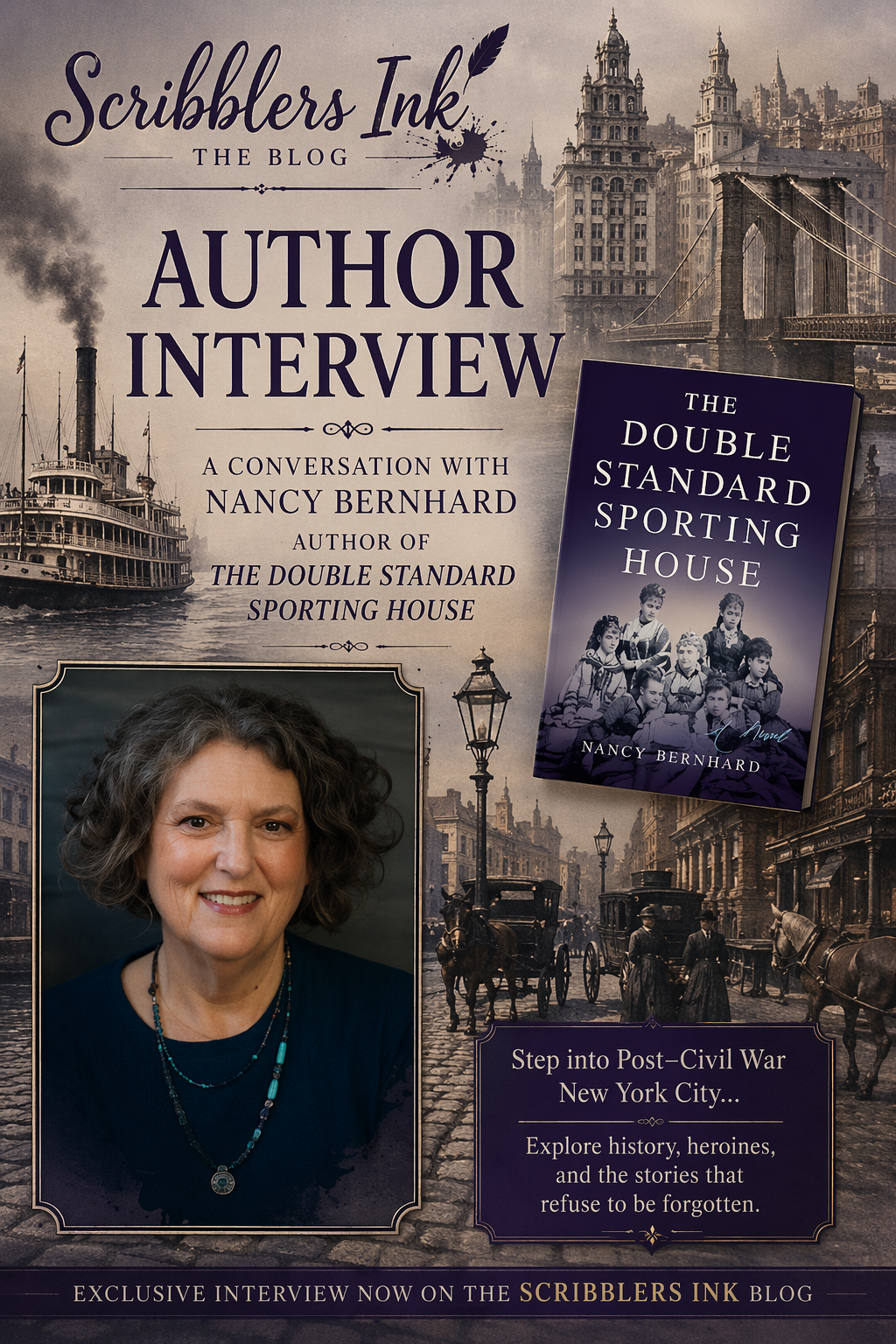
Interview with Author Nancy Bernhard
/
From the first pages I was drawn into this world, what first sparked the idea for the Double Standard Sporting House?
When I was a teen, my fun and flamboyant grandmother Ruth told me that during the 1920s when she was a teen, she discovered that her Aunt Beadie was a madam. I was shocked and probably changed the subject, but always wondered how a middle-class girl from a large, supportive family ended up in the sex trade. Decades later in 2020, I finally asked my 87-year-old father about it. It turned out that Beadie lived with a man whose wife had been long institutionalized. When his wife passed, he married Beadie and they had a long and happy life together. But in my grandmother’s youth, any woman having sex outside of married monogamy was branded a sex worker, and because Ruth exaggerated everything, she made Beadie into a madam.
As the first summer of the lockdown turned to fall, I decided to spend that winter diving into the historical question of how girls ended up in the sex trade, with the idea of turning it into a novel.
The way you weaved history and story felt seamless. Can you share a bit about out your research process and how you balance fact with fiction?
Thank you! I started off by reading everything I could find about the sex trade in 19th century New York, and about women’s reproductive healthcare in that era. In her book Their Sister’s Keepers: Prostitution in New York City, 1830-1870, Marilyn Wood Hill mentioned that a unique era of female control of the sex trade ended around 1870 with the city’s takeover by the Tammany Hall political syndicate. That half-line seeded the plot and antagonists. But there are actually very few, if any, primary sources about sex workers on the whole east coast of the US in the second half of the 19th century. Everything is filtered through the lenses of men who were trying to exploit or reform them. Where there is historical documentation, I respected it and often used it, but where the record ended or I thought it was misleading, I felt free to make things up.
For instance, Peter Sweeny was a real person whose history and role in Tammany, as well as his unusual character, are well-documented, and I kept all of that. The descriptions of his manner were familiar to me as an atypical neurology, so I embroidered his character from there. But we know nothing about Sweeny’s sex life beyond his late marriage, so I invented all of that history for him.
Nell “Doc” Hastings is such a multi-layered and compelling protagonist. How did her voice come to you or did she evolve as you wrote?
As I was thinking about my great-great-Aunt Beadie, and how a middle-class girl might end up as a madam (though she didn’t), I began to envision a smart, skilled girl who by no fault of her own ends up in the demimonde. On the one hand, I could see her, and knew her as a human being, but on the other hand, she carried the weight of all my thematic ambitions for the book. I wanted her to embody traditionally feminine strengths of healing, compassion, and community, and to pit those strengths against traditionally masculine behaviors of domination, competition, and predation, in a high stakes conflict. Her “fall” from respectability would enable her to see through the injustices women suffered more clearly than most people, and her resourcefulness would lead her to make the most of her situation. Doc discovers that she has far more freedom and achieves much more than she would have, had she not ended up on the wrong side of that divide. It was a lot to hang on this woman.
Because of that, in the first drafts of the book, her voice was a bit more know-it-all and secretive about her past, a bit too inhuman. She softened and grew more nuanced with each draft. Adding the flashbacks helped. The longer I lived with her, the more emotional and more human she became.
What drew you to this theme of women carrying out their own power and independence in a time when those options were severely limited?
Though women’s options are greatly expanded from the extremes of 1868, our power is still limited and undervalued. We earn 80% of what men do. We spend untold energy and time protecting ourselves from sexual assault, or recovering from it. We are still reduced to our reproductive function, carry the great majority of the burden of sex and childrearing, and are also punished and shamed for carrying that burden. Going back in time magnifies and clarifies the restrictions, exclusions, and inequalities we face now. Plus, brothels were a common feature of New York life in this time period—more than 600 in 1868—and I found it an irresistible setting.
You pacing builds in such a wonderful way, do you outline plots in advance or do you have a loose outline and most of the story reveals itself as you write?
Somewhere in between. I always want the big picture in mind, and spend a lot of time outlining and shaping the story, but it shifts as I write and learn more about the story, so I re-outline and re-shape. I use oversized, unlined drawing paper for that.
By far the hardest thing about writing this book was introducing the reader to this complex, unfamiliar setting and all the characters without slowing the pace too much. I rewrote the opening many, many times, and learned a lot about building narrative drive.
There’s a fascinating tension between the danger of the world you’ve created and the deep sense of community among the women. Was that contrast intentional from the start?
Yes. I wanted to celebrate women’s power. The realms left to us – home, sexuality, nurturing, connection – are crucial, and often invisible to powerful men even when they rely on it and exploit it. The secrets held in a brothel are very powerful currency. Doc understands this very well, and saves important secrets to use at the right moment.
Certainly these are not women’s only strengths, but historically we have made the most of what we’ve been allowed, and created strong, healing communities even if they’re unseen and undervalued by men bent on exploitation.
Your writing transports the reader so fully into post-Civil War New York City. What does your writing process look like when you’re trying to bring a historical setting to life?
I need to see a scene in my mind’s eye before I can write it. Sometimes that means having an historian’s understanding of, say, how Tammany Hall operated at different levels, and how ordinary people would interact with it. I’ve been an academic historian for a long time, so I have a good amount of reading and research experience to draw on for that. But sometimes I’m trying to find a very particular detail: what was the standard of care for syphilis in 1868? What would a female medical practitioner or an elite harlot wear? So, before I ever start writing, I read everything I can find that might help me understand this world broadly—how politics, society and culture function—and then sometimes I leave brackets in the draft because I have to go back and find out what people ate for breakfast.
This story felt both historical and timely. Were there any modern parallels you were consciously exploring as you wrote?
Unfortunately, systematic sexual exploitation of girls and women occurs in every era of history. It’s always timely. Since the pussy-grabbing revelations of 2016 we’ve known that Donald Trump is a predator. The latest shocking revelations about trafficking by Jeffrey Epstein and the degree to which powerful men in business, academics, and the arts participated emerged after the book was in press. The parallels between Tammany Hall as a wildly corrupt and misogynistic syndicate and the MAGA-dominated Republican party are hard to miss, but I was addressing this perpetual aspect of patriarchy rather than drawing direct parallels.
When it comes to your writing routine: are you someone who writes every day or do you work in bursts when inspiration strikes?
When I’m writing a first draft, I get up very early and write by hand in my kitchen before the world is awake. Some weeks I work very intensely every day, and then others I’m thinking about what comes next, or reading, or busy with other things. Revision is looser; the second draft is always where the tough problems get ironed out, and that can be anywhere, anytime. And later I love fine-tuning the language after the big pieces are in place. I can go over the same pages many times a day.
Do you have any rituals or habits when it comes to your writing time, such as notebooks, certain time of day, music, munchies, that help you get into the writing flow?
I need the quiet house and quiet mind of those early morning hours to create, to conjure something out of nothing. I write in spiral notebooks, and try to plan what I’m going to work on the day before, so that when I sit down there’s no wind-up, I can just begin. And then later in the day, my home office is cozy and full of books, a sunny place to read or work on the computer, which helps keep me there.
What’s next for you? Is there a sequel? More stories set in this world? Or a jump to a different genre entirely?
I do have a new and very different novel underway, set in the late 1960s in the music scene in Los Angeles. But I’m also inching along with a project I started years ago about the legendary war correspondent Martha Gellhorn, which hasn’t found its form yet. We’ll see which one gets finished first.
Nancy Bernhard is a novelist and historian of American journalism who lives in Somerville, MA. She is the author of US Television News and Cold War Propaganda, 1947-60 (Cambridge University Press), and has a particular interest in how war correspondents have covered atrocities. She is also a longtime yoga student and teacher, who works with survivors of sexual assault. Her historical and somatic interests converged in the study of how we have understood and treated trauma from both war and rape over the last two centuries. The heroine of her first novel, The Double Standard Sporting House (She Writes Press, 2026), is an imagined pioneer in the medical treatment of survivors.
https://www.nancybernhard.com/
https://www.instagram.com/nancy.bernhard.author/